
Views: 22 Author: Site Editor Publish Time: 2026-01-02 Origin: Site


If you have ever watched an excavator dig a trench or a crane lift a steel beam, you have seen a hydraulic cylinder in action. These powerful mechanical muscles are the unsung heroes of modern industry, capable of lifting, pushing, and pulling loads that no human or simple motor could handle alone. But how exactly does a tube filled with oil generate enough force to move mountains?
The answer lies in the conversion of fluid pressure into linear mechanical motion. While the concept sounds simple—push fluid in, push piston out—the engineering behind it is a fascinating blend of physics and precision manufacturing. For engineers, equipment operators, and maintenance professionals, understanding how a hydraulic cylinder works is not just academic; it is essential for optimizing performance, troubleshooting issues, and ensuring safety on the job site.
In this guide, we will break down the science, the components, and the step-by-step operation of hydraulic cylinders to reveal exactly how they turn liquid energy into raw power.
To understand how a hydraulic cylinder works, we first need to look at the physics that makes it possible. It isn’t magic; it’s fluid dynamics. The operation relies on a few fundamental laws of physics that dictate how liquids behave under pressure.
The foundation of all hydraulic systems is Pascal’s Law. Discovered by Blaise Pascal in the 17th century, this principle states that when pressure is applied to a confined fluid, it is transmitted undiminished in all directions.
In the context of a hydraulic cylinder, this means that when a pump forces hydraulic oil into the cylinder barrel, that pressure pushes equally against every square inch of the interior surface. Since the walls and the cap are fixed, the only movable part is the piston. Consequently, the fluid pushes the piston, converting that static pressure into movement. This uniform transmission is why hydraulics are so smooth and consistent compared to mechanical gears or levers.
One of the most valuable aspects of hydraulic cylinders is their ability to multiply force. The relationship between pressure, the size of the cylinder, and the resulting force is governed by a simple equation:
Force (F) = Pressure § × Area (A)
Pressure §: The intensity of the fluid entering the cylinder (usually measured in PSI or bar).
Area (A): The surface area of the piston face that the fluid pushes against.
This means you can generate massive amounts of force without needing an equally massive pump. By simply increasing the surface area of the piston, a relatively moderate input pressure can result in a tremendous output force. This is how a small operator moving a lever can lift tons of rock.
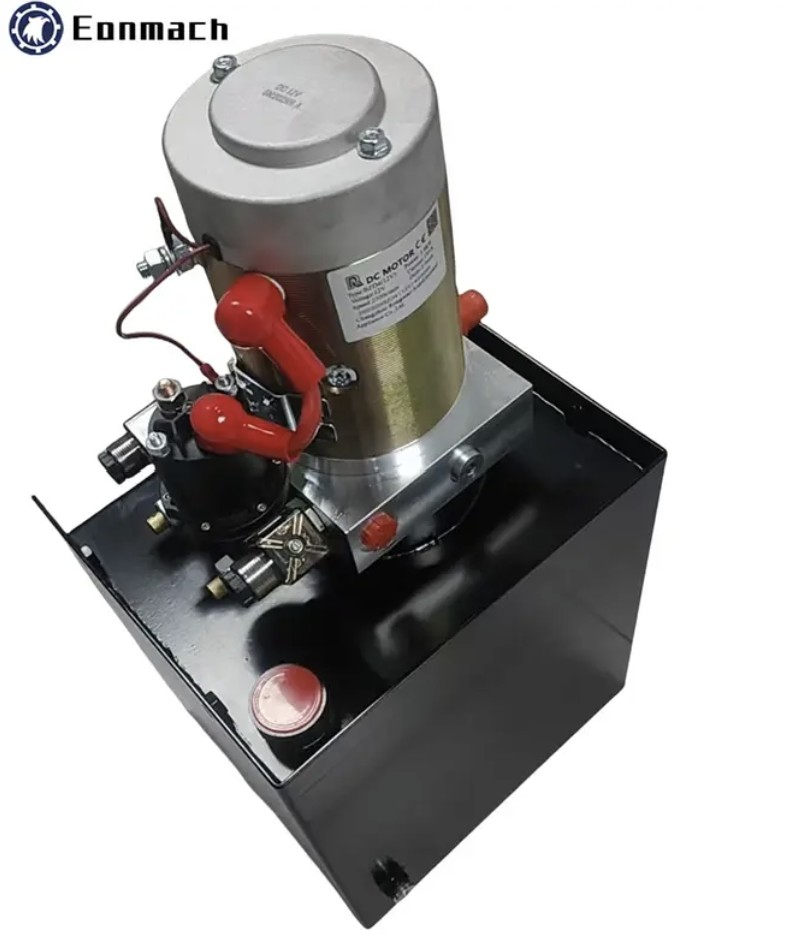
A hydraulic cylinder is technically an actuator—a device that converts energy into motion. The system starts with a prime mover (like an electric motor or diesel engine) driving a hydraulic pump. This pump creates flow, converting mechanical energy into hydraulic energy (fluid under pressure).
When this pressurized fluid enters the cylinder, the cylinder performs the final conversion: turning that hydraulic energy back into linear mechanical energy. This linear motion—straight out and straight back—is what differentiates cylinders from hydraulic motors, which generate rotary motion.
Why use oil? Why not air? Pneumatic cylinders use compressed air, but they are “spongy” because gases are compressible. If you push against a heavy load with air, the air compresses before the load moves.
Hydraulic cylinders typically use oil because liquids are virtually incompressible. This creates a rigid link between the controls and the movement. When you stop the flow of oil, the cylinder stops instantly and holds its position without bouncing back. This allows for the millimeter-precise control required in robotics and heavy machining.
Force is useless without control. In a hydraulic cylinder, the direction of movement is determined by where the fluid enters.
Extension: Fluid is pumped into the “cap end” (the bottom) of the cylinder, pushing the piston forward.
Retraction: Fluid is pumped into the “rod end” (the top), pushing against the annular area around the rod to pull the piston back.
The ability to handle high pressure allows cylinders to be power-dense. A hydraulic system can operate at pressures ranging from 2,000 to over 5,000 PSI. When you apply 3,000 pounds of pressure per square inch against a piston with a 10-inch surface area, you generate 30,000 pounds of force. This high power-to-weight ratio is why hydraulic cylinders are the standard for heavy-load applications like mining, construction, and aerospace.
Now that we understand the physics, let’s look at the operational sequence. How does the fluid actually get from the tank to the piston to create movement?
The process begins at the reservoir, where hydraulic oil is stored. A hydraulic pump draws this oil out and pushes it into the system lines. However, the fluid doesn’t go straight to the cylinder; it passes through a directional control valve. This valve acts as the traffic cop, deciding whether the fluid goes to the extend side, the retract side, or back to the tank. When the operator activates the system, the valve opens the path to the cylinder port.
As pressurized fluid floods into the sealed chamber of the cylinder barrel, pressure builds up. Once this force exceeds the resistance of the load attached to the rod, the piston begins to move. The speed of this movement is determined by the flow rate of the fluid (gallons per minute), while the strength of the movement is determined by the pressure.
During the extension stroke, fluid fills the blind end (cap end) of the cylinder. The hydraulic oil pushes against the full face of the piston. As the piston moves forward, it pushes the piston rod out of the cylinder barrel. This rod is connected to the machine component—the bucket of an excavator, the bed of a dump truck, or the press plate of a compactor—transferring the force to do physical work.
To retract the cylinder, the directional control valve shifts. It cuts off the flow to the cap end and directs high-pressure fluid to the rod end. The fluid now enters the chamber surrounding the piston rod.
It is important to note that a cylinder usually has less force during retraction. Why? Because the piston rod takes up space inside the barrel. The fluid has less surface area on the piston face to push against. The fluid on the other side (cap end) is forced out through the return line and back into the reservoir, completing the cycle.
A hydraulic cylinder might look like a simple metal pipe, but inside, it is a precision-engineered assembly. Every component plays a critical role in containing pressure and ensuring smooth motion.
The barrel is the seamless steel tube that holds the pressure. It must be strong enough to withstand thousands of PSI without expanding or bursting. The interior surface is honed to a mirror-like finish. This smoothness is vital; a rough surface would destroy the seals and cause internal leakage, drastically reducing efficiency.
The Piston: This is the disc inside the barrel that separates the two chambers. It is machined with grooves to hold seals that prevent oil from bypassing it.
The Piston Rod: This is the hard, chrome-plated steel shaft that connects the piston to the outside world. It must be incredibly tough to resist bending and have a super-smooth surface to slide through the rod seals without leaking.
The cylinder is closed off by two ends. The cap (or base) is usually welded to the barrel and provides a mounting point. The head (or gland) is screwed or bolted onto the other end. The head contains the rod wiper and rod seals, allowing the piston rod to slide in and out while keeping the pressurized oil inside and dirt outside.
Seals are the most vulnerable but essential parts of the system.
Piston Seals: Prevent fluid from leaking between chambers.
Rod Seals: Prevent fluid from leaking out of the cylinder.
Wiper Seals: Scrape dirt and debris off the rod as it retracts to prevent contamination.
Wear Bands (Bearings): Guide the piston and rod, preventing metal-to-metal contact between the moving parts and the barrel.
A hydraulic cylinder cannot work in isolation. It is part of a larger, interconnected circuit.
The cylinder is the muscle, but the pump is the heart. Without the pump creating flow, the cylinder has no energy to convert. Different types of pumps (gear, vane, or piston) provide different flow rates and pressure capabilities, which dictate how fast and how hard the cylinder can push.
Valves provide the brainpower.
Directional Control Valves: Tell the cylinder to extend or retract.
Flow Control Valves: Regulate speed by restricting how much oil enters the cylinder.
Pressure Relief Valves: Act as safety devices, diverting fluid back to the tank if pressure gets too high, preventing the cylinder from bursting.
The fluid does more than just transmit power. It lubricates the internal seals and wear bands to reduce friction. It also acts as a coolant, carrying heat generated by the system back to the reservoir where it can dissipate. This triple function is why maintaining clean fluid is critical for cylinder longevity.
In complex machinery, multiple cylinders often work together. For example, an excavator boom uses several cylinders extending and retracting simultaneously. This requires sophisticated system coordination, often using load-sensing valves to ensure that pressure is distributed correctly so all cylinders move smoothly, regardless of the load they are carrying.
Not all cylinders perform the same way. Several variables influence their efficiency and capability.
Operating pressure is the primary factor in force capability. A cylinder rated for 3,000 PSI will generate significantly more force than one rated for 1,500 PSI, assuming the size is the same. However, running a cylinder above its rated pressure can cause seal failure or structural damage.
Bore Size (Diameter): A larger bore creates a larger surface area for the oil to push against, increasing force but requiring more fluid to move at the same speed.
Stroke Length: This determines how far the cylinder can travel. Long-stroke cylinders require special design considerations (like stop tubes) to prevent the rod from buckling under heavy loads.
The viscosity (thickness) of the oil matters. If the oil is too thin (often due to high heat), it may leak past internal seals, causing the cylinder to drift or lose power. If it is too thick (due to cold), the system becomes sluggish. Specialized synthetic or water-based fluids are used in environments requiring fire resistance or extreme temperature tolerance.
The environment dictates the materials. In marine applications, standard steel rods would rust quickly. Therefore, cylinders used near saltwater often feature nickel-chrome plating or ceramic coatings to resist corrosion. The surface finish of the rod is also critical; even minor scratches can shred seals and cause leaks.
Theory is great, but where do we see this technology in the real world?
Construction is the most visible application. The “arm” of an excavator relies on boom, stick, and bucket cylinders. These must withstand extreme shock loads and dirty environments. They provide the breakout force needed to tear through rock and soil.
Inside factories, hydraulic cylinders power injection molding machines, metal presses, and conveyor systems. Here, the focus is on repeatability and cycle speed. These cylinders often work 24/7 and require high-durability seals to handle the heat generated by constant operation.
Forklifts and scissor lifts rely on hydraulic cylinders to raise heavy pallets. These cylinders typically use single-acting mechanisms (powered extension, gravity retraction) for lifting, focusing on stability and safety to prevent loads from dropping.
Modern hydraulics are becoming incredibly precise. In hydraulic robotics (like those used in animatronics or disaster relief robots), servo-hydraulic cylinders can move fractionally, mimicking the dexterity of human muscles but with superhuman strength.
Despite their toughness, hydraulic cylinders are not invincible. Understanding common failure modes helps in prevention.
If a cylinder feels weak or slow, it is often due to internal leakage. This happens when the piston seal wears out, allowing oil to bypass from the high-pressure side to the low-pressure side. The fluid circulates inside the barrel, but the piston doesn’t move effectively.
External leakage around the rod is the most obvious sign of failure. This is usually caused by a damaged rod seal or a scratched piston rod. Once a seal fails, dirt can enter the system, causing a domino effect of damage to other components.
“Stick-slip” or juddering happens when the cylinder moves in jerky jumps rather than a smooth slide. This can be caused by air trapped in the fluid (which makes it compressible) or high friction due to lack of lubrication.
To keep a cylinder working:
Keep the oil clean: Contamination is the #1 killer of hydraulic components.
Inspect the rod: Look for nicks, dents, or rust that could damage seals.
Check connections: Ensure hoses and fittings are tight to prevent air ingress or oil leaks.
The hydraulic cylinder is a masterpiece of engineering efficiency. By harnessing the simple physics of Pascal’s Law, it transforms pressurized fluid into the controlled linear motion that builds our cities, manufactures our goods, and powers our heavy machinery.
Whether you are designing a new system or maintaining an old excavator, understanding the interplay between the pump, the fluid, and the cylinder internals is the key to unlocking reliable power. As technology advances, these components are becoming smarter and more efficient, but the core principle remains the same: fluid under pressure, working harder than any solid gears ever could.
EONMACH is a professional hydraulic cylinder manufacturer specializing in design, manufacturing, and system solutions. With ISO 9001-certified production and 10+ years of experience, we deliver standard and custom hydraulic cylinders, power units, and valves worldwide. Contact us to discuss your hydraulic solution.