
Views: 5 Author: Site Editor Publish Time: 2026-09-24 Origin: Site


A hydraulic cylinder converts hydraulic pressure into controlled linear force and motion.
In practical terms, it allows a machine to push, pull, lift, lower, clamp, tilt, position, or hold a load by using pressurized hydraulic fluid to move a piston inside a cylinder barrel.
That is the core function.
A hydraulic cylinder is therefore not simply a metal tube with a moving rod. It is the component that turns hydraulic energy into useful mechanical work.
This is why hydraulic cylinders appear in equipment as different as excavators, agricultural machines, scissor lifts, dock levelers, dump trucks, garbage trucks, medical beds, forklifts, and industrial machinery. EONMACH's current product range covers these and other mobile and industrial applications.
The simplest way to understand a hydraulic cylinder is to follow the energy path.
A hydraulic power unit or pump creates fluid flow. Pressure develops when that flow encounters resistance from a load. The pressurized oil enters the cylinder and acts on the piston. The piston then moves, carrying the piston rod and whatever machine component is connected to it.
So the sequence is:
hydraulic pressure → piston force → rod movement → machine movement
The cylinder does not create energy by itself. It converts hydraulic energy supplied by the system into straight-line mechanical movement.
That movement can be very small and precise or long and powerful depending on the cylinder design.
For example, EONMACH publishes hydraulic-cylinder configurations with working pressures from about 7 MPa to 31.5 MPa, bore sizes from 20 mm to 500 mm, and stroke lengths from 20 mm to 8000 mm across its broader cylinder range.
A single hydraulic cylinder can perform different mechanical tasks depending on how it is mounted and connected to the machine.
Cylinder Function | What the Cylinder Does | Typical Example |
|---|---|---|
Lifting | Raises a load vertically or through a linkage | Scissor lift, dock leveler |
Pushing | Applies straight-line force away from the cylinder | Press, loader mechanism |
Pulling | Retracts to draw a component inward | Double-acting machinery |
Tilting | Changes the angle of a structure | Dump body, bucket |
Positioning | Moves a component to a controlled location | Industrial equipment |
Clamping | Applies and maintains holding force | Machine tooling |
Steering | Changes wheel or mechanism direction | Tractor steering |
Stabilizing | Extends supports to hold equipment steady | Outrigger system |
Height adjustment | Raises or lowers a platform or bed | Medical bed, chair lift |
Repetitive actuation | Repeats controlled linear cycles | Production machinery |
These actions all come from the same basic principle: hydraulic pressure acts over an area to generate force, and that force moves the piston.
The force produced by a hydraulic cylinder depends mainly on two factors:
hydraulic pressure and effective piston area.
The simplified force relationship is:
Force = Pressure × Area
This means that increasing hydraulic pressure or increasing piston area can increase the theoretical force available from the cylinder.
A larger bore gives the hydraulic oil more piston area to act against. That can create more force at the same pressure.
However, larger is not automatically better.
Increasing bore size also increases the amount of oil required to move the piston through a given distance. If pump flow remains unchanged, the cylinder may move more slowly.
Cylinder design therefore involves a balance between:
required force,
available pressure,
desired speed,
available oil flow,
and installation space.
This is why hydraulic cylinders are usually selected from application requirements rather than from bore diameter alone.
Hydraulic cylinders are linear actuators.
The piston moves back and forth inside the barrel, so the piston rod naturally creates straight-line motion.
Machines can then convert that linear movement into other forms of motion through linkages.
For example, an excavator boom rotates upward around a pivot, but the cylinder itself still extends in a straight line. The mechanical linkage converts cylinder extension into angular boom movement.
A dump truck body also rotates around a hinge, yet the hydraulic cylinder produces linear extension.
This distinction is important because the cylinder's actual force changes according to the linkage geometry and angle of operation.
The machine may therefore require different cylinder force at different points in the stroke even when hydraulic pressure remains similar.
During extension, hydraulic fluid enters the working chamber on the piston side.
Pressure acts over the piston area and pushes the piston toward the opposite end of the barrel. The rod moves outward at the same time.
That outward movement can be used to lift, push, tilt, separate, stabilize, or position a load.
Consider a scissor lift.
As the hydraulic cylinder extends, it pushes the scissor mechanism. The linkage opens and raises the platform.
The cylinder itself does not travel vertically by the full height of the platform. Instead, its relatively short linear movement is converted by the scissor structure into a larger vertical platform movement.
EONMACH currently lists double-acting hydraulic cylinders for scissor-lift applications as part of its cylinder portfolio.
Retraction brings the piston rod back into the cylinder.
How that happens depends on the cylinder design.
A single-acting cylinder normally uses hydraulic pressure in one direction and relies on gravity, a spring, or an external load to return.
A double-acting cylinder uses hydraulic pressure on both sides of the piston, allowing powered extension and powered retraction.
This difference matters in real machines.
A dock leveler may be able to return through gravity, making a single-acting design practical. EONMACH currently lists a single-acting hydraulic cylinder specifically for dock-leveler applications.
An excavator arm, by comparison, needs controlled force in both directions. That makes double-acting operation much more appropriate.
Hydraulic cylinders are widely used because they can generate substantial force from relatively compact components. They achieve this by using fluid pressure acting on the piston area. If two systems operate at the same pressure, a small-bore cylinder has a relatively small piston area, while a larger-bore cylinder has a greater piston area. As a result, the larger piston can theoretically generate greater linear force at the same hydraulic pressure. This principle makes hydraulic cylinders suitable for heavy-duty machinery such as excavators, lifting equipment, agricultural machinery, garbage trucks, material-handling equipment, and construction machinery. EONMACH states that its hydraulic cylinders are designed for stable force and controlled movement across industrial and mobile applications, including agriculture, construction, lifting, logistics, medical equipment, and waste-management vehicles.
Force is only one part of the cylinder's job.
Many machines also rely on the cylinder to put a component in a specific position.
Consider an excavator bucket.
The operator does not simply need the bucket to move with maximum force. The bucket must move through a controlled arc so material can be collected, carried, and released accurately.
EONMACH's current small-excavator cylinder information emphasizes responsive operation, precise movement control, and smooth start and stop for boom, arm, bucket, dozer, and swing functions.
In more advanced hydraulic systems, cylinder position can also be monitored using sensors and controlled through proportional or servo hydraulic systems.
The cylinder then becomes part of a closed-loop positioning system rather than simply an extend-and-retract device.
A hydraulic cylinder may also be required to hold a machine component or load at a selected position. This is especially important in lifting systems, outriggers, platforms, booms, industrial fixtures, and vehicle equipment. In these applications, maintaining a stable position can be just as important as moving the load itself.
Holding a load safely often requires more than simply stopping pump flow. The hydraulic circuit may use load-holding valves, pilot-operated check valves, counterbalance valves, or other control components, depending on the load direction and safety requirements. This is why cylinder behavior cannot always be evaluated independently from the hydraulic valve system. EONMACH manufactures hydraulic cylinders, hydraulic power units, and hydraulic control valves, and its application pages describe these components as parts of complete hydraulic systems.
In an excavator, hydraulic cylinders turn hydraulic power into controlled digging movement.
Different cylinders perform different jobs.
The boom cylinder raises and lowers the main boom.
The arm cylinder changes the reach of the digging assembly.
The bucket cylinder curls and uncurls the bucket.
On some compact machines, other hydraulic cylinders may also operate the dozer blade or additional mechanisms.
EONMACH's small-excavator cylinder page currently lists boom, arm, bucket, dozer, and swing applications and notes that bore, stroke, and installation method can be customized.
In this environment, the cylinder must do more than produce force. It must also tolerate changing load direction, shock, contamination, vibration, and frequent operating cycles.
Agricultural machinery uses hydraulic cylinders to control implements and working mechanisms.
A tractor may use a hydraulic cylinder to raise or lower a plow. Harvesting equipment may use cylinders to position headers or other attachments. Other agricultural machinery may use them for steering, folding, leveling, or adjusting working depth.
EONMACH specifically describes hydraulic cylinders in agricultural applications as controlling the lifting and lowering of implements such as plows and harvesting devices, helping maintain working depth and reduce manual intervention.
The working environment adds another requirement.
Agricultural cylinders often operate around dust, mud, water, fertilizer, vibration, and outdoor temperature changes, so sealing, rod protection, corrosion resistance, and robust mounting become important.
Lifting equipment makes the function of a hydraulic cylinder particularly easy to understand. The cylinder receives hydraulic pressure and converts it into lifting force, but the exact role changes depending on the machine.
Scissor lifts: The hydraulic cylinder pushes the scissor linkage, causing the platform to rise or lower.
Home and freight lifts: The cylinder may directly or indirectly raise and lower the platform.
Dock levelers: The cylinder adjusts platform height so loading equipment can align correctly with a vehicle.
Chair lifts and medical equipment: Hydraulic cylinders help provide controlled lifting and positioning where smooth movement is important.
Truck lift systems: The cylinder supplies the force needed to raise, lower, or position lifting structures used on vehicles.
EONMACH's current hydraulic-cylinder catalog includes products for chair lifts, medical beds, scissor lifts, dock levelers, truck lift systems, and other lifting applications. In these systems, smooth starting and stopping are often important because uncontrolled movement can create shock, instability, or unnecessary stress on the equipment.
A dump truck needs to raise the body through a large angle to unload material.
The available mounting space beneath the body is limited, so telescopic hydraulic cylinders are commonly used.
Instead of relying on one long piston rod, a telescopic cylinder contains several nested stages.
As the stages extend, the overall length increases dramatically.
The cylinder's job is to convert hydraulic pressure into the lifting movement that rotates the dump body around its hinge.
EONMACH currently lists both a tipper-trailer telescopic hydraulic cylinder and a long-stroke multi-stage telescopic cylinder for dump-truck applications.
This is a good example of how cylinder structure changes according to what the machine needs to accomplish.
An outrigger cylinder stabilizes equipment.
Instead of continuously moving a machine component during normal operation, it extends a support leg or stabilizing mechanism until the machine has a secure operating base.
Outriggers are commonly used where equipment needs greater stability before lifting, loading, or performing another high-load operation.
The cylinder therefore has two closely related jobs:
position the stabilizer and maintain controlled support under load.
EONMACH's current product catalog includes outrigger hydraulic cylinders among its available hydraulic-cylinder solutions.
In these systems, mounting strength and load-holding control can be just as important as extension force.
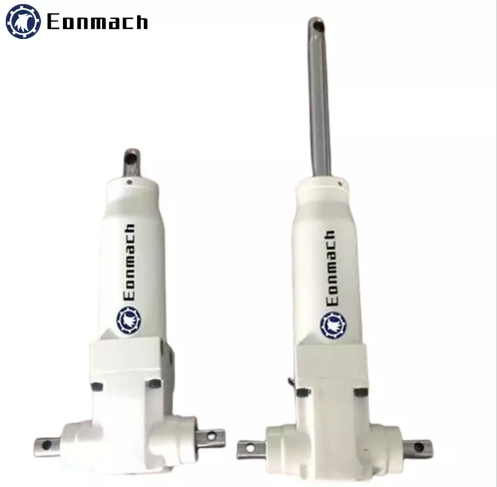
A hydraulic cylinder cannot perform correctly without the rest of the hydraulic circuit.
Think of the system as a team.
The pump or hydraulic power unit provides flow.
The control valve directs that flow.
The cylinder converts hydraulic energy into linear movement.
The reservoir, filtration, hoses, fittings, and other components support fluid circulation and system reliability.
If the pump cannot supply enough flow, the cylinder may move too slowly.
If the pressure is insufficient, the cylinder may not produce enough force.
If the valve is incorrectly sized, movement may be unstable or restricted.
If the hydraulic lines are undersized, pressure loss and heat can increase.
So while the cylinder is the component performing the visible mechanical work, its behavior depends on the whole hydraulic system.
Both convert hydraulic energy into mechanical motion, but they produce different types of movement.
A hydraulic cylinder primarily creates:
linear motion
A hydraulic motor primarily creates:
rotary motion
If a machine needs to push a platform upward, a cylinder is usually appropriate.
If a machine needs continuous shaft rotation, a hydraulic motor may be more suitable.
The two can also exist in the same machine.
An industrial system may use hydraulic cylinders for positioning and hydraulic motors for rotation.
Understanding the required movement is therefore one of the first steps in selecting a hydraulic actuator.
The cylinder's actual capability depends on more than its general type.
A useful way to think about this is to connect each design parameter to a machine result.
Cylinder Parameter | Main Effect on Performance |
|---|---|
Bore diameter | Influences available force |
Rod diameter | Influences retract force and structural strength |
Stroke | Determines maximum linear travel |
Working pressure | Influences available force and component loading |
Oil flow | Influences cylinder speed |
Mounting style | Determines how force enters the machine structure |
Seal system | Influences leakage control and service life |
Cushioning | Controls end-of-stroke deceleration |
Port size | Influences available oil flow |
Cylinder construction | Influences packaging, serviceability, and application fit |
This is why two cylinders with the same stroke can perform very differently.
One may be designed for a relatively light medical-bed application, while another may operate under heavy construction loads.
A hydraulic cylinder is strongest when force acts along its intended axis.
Poor mounting can introduce side load.
Side loading forces the rod against guide and bearing surfaces rather than allowing it to move cleanly along the cylinder centerline.
Over time, this can contribute to:
uneven seal wear,
rod damage,
guide wear,
leakage,
friction,
and reduced service life.
The correct mounting arrangement depends on how the machine moves.
Pins, clevises, trunnions, flanges, and other mounting styles allow the cylinder to interact differently with the surrounding structure.
EONMACH states that customizable mounting types and connection structures are available based on drawings or project specifications.
Stroke is the distance the piston can travel from one end of the cylinder to the other.
If the stroke is too short, the machine cannot reach its required position.
If it is excessively long, the cylinder may become unnecessarily large, difficult to install, or structurally less suitable for the machine.
A long rod under compression can also face buckling concerns, especially when the cylinder is heavily loaded.
Stroke therefore needs to be matched to actual machine geometry.
EONMACH's published hydraulic-cylinder information currently lists customizable strokes from approximately 20 mm to 8000 mm across its wider product range.
The correct stroke for any particular product still depends on the machine and installation.
A cylinder's job may be the same, but the speed required to perform it can differ dramatically.
A medical bed may prioritize gentle and controlled movement.
A production machine may need frequent repeatable cycles.
Construction machinery may require responsive operator control.
Speed is primarily influenced by hydraulic oil flow compared with the cylinder's effective area.
A larger bore generally requires more oil flow to achieve the same linear speed.
This means cylinder force and cylinder speed are connected through system sizing.
Choosing a large bore for force without checking available pump flow can result in a cylinder that performs the required load movement too slowly.
Hydraulic cylinders are not limited to manually controlled machinery.
They can be integrated with:
electrical sensors,
position sensors,
proportional valves,
PLC systems,
electronic controllers,
and automated hydraulic circuits.
In these systems, the cylinder becomes the physical output device of an automation command.
A control system determines where the machine should move.
A valve adjusts fluid flow.
The hydraulic cylinder then turns that command into actual mechanical movement.
EONMACH's application materials describe hydraulic systems used for precise positioning and synchronized control in industrial and logistics applications.
A hydraulic cylinder cannot independently decide:
when to move,
how fast to move,
what pressure to use,
or when to stop.
Those functions depend on the hydraulic and control system around it.
The cylinder also does not automatically provide safe load holding simply because the rod has stopped moving.
Safety-critical equipment may need additional valves or mechanical locking systems.
Likewise, a cylinder cannot compensate for severe mechanical misalignment. If a machine forces the rod sideways, increasing hydraulic pressure will not correct the geometry.
Understanding these limitations helps prevent a common mistake: treating the cylinder as the entire hydraulic system.
It is only one highly important part of that system.
Selection should start with the machine function.
If the cylinder must lift a load, calculate the required force and account for the machine's mechanical leverage.
If it must move in both directions under power, a double-acting configuration may be appropriate.
If the installation needs a very long stroke in limited space, a telescopic design may be worth considering.
After that, define:
required force,
working pressure,
bore,
rod diameter,
stroke,
extension and retraction speed,
mounting arrangement,
duty cycle,
hydraulic fluid,
operating temperature,
environmental conditions,
and control requirements.
EONMACH offers both standard and customized hydraulic-cylinder solutions and states that cylinders can be developed according to customer drawings, specifications, and application requirements.
EONMACH's current hydraulic cylinder portfolio shows how the same fundamental hydraulic principle can serve very different machine functions.
The product range includes cylinders for:
agricultural machinery,
construction machinery,
small excavators,
dock levelers,
scissor lifts,
chair lifts,
medical beds,
dump trucks,
outriggers,
skip loaders,
waste-handling vehicles,
and customized equipment.
Across these applications, the basic function remains the same:
convert hydraulic energy into controlled linear force and movement.
What changes is the cylinder's bore, rod, stroke, mounting, pressure, seals, structure, and control arrangement.
The main purpose is to convert hydraulic pressure into linear mechanical force and motion. This allows machinery to lift, push, pull, tilt, clamp, position, or stabilize loads.
It can do either. A single-acting cylinder usually provides powered force in one direction, while a double-acting cylinder can normally provide controlled hydraulic force during both extension and retraction.
Pressurized oil acts on the piston area inside the cylinder. The combination of hydraulic pressure and piston area generates linear force that can lift the load directly or through a mechanical linkage.
Cylinder speed is mainly influenced by hydraulic flow rate and effective piston area. Valves, hoses, ports, load, leakage, and fluid conditions can also affect actual speed.
Hydraulic cylinders are well suited to applications requiring strong linear force in a compact package. Electric motors naturally produce rotary motion and may require additional mechanisms when straight-line movement is needed.
So, what does a hydraulic cylinder do?
It converts hydraulic pressure into controlled straight-line force and motion.
That basic function allows a machine to:
lift → push → pull → tilt → position → clamp → stabilize
The cylinder may raise an excavator boom, tilt a dump body, adjust a dock leveler, move an agricultural implement, position a medical bed, or stabilize a machine through an outrigger.
Although the operating principle is straightforward, the correct cylinder design depends on the work it must perform.
Force determines the required bore and pressure. Stroke determines travel. Flow influences speed. Rod diameter affects structural performance and retract-side area. Mounting determines how force enters the machine, while seals, cushioning, materials, and control components influence reliability.