
Views: 9 Author: Site Editor Publish Time: 2026-04-10 Origin: Site


A hydraulic cylinder is a machine part that makes strong straight movement by using fluid under pressure. You can find it in many fields because it gives a lot of force and good control in a small size. Companies like Qingdao Eonmach Machinery Company Limited make these cylinders for cars, hospitals, farms, and trash systems.
The world market for these devices is about USD 14.4 billion in 2024. It is getting bigger because many people need them for building, farming, and mining.
You see hydraulic cylinders in machines like diggers, cranes, tractors, and factory lines. They help these machines work better and faster.
Hydraulic cylinders use fluid power to make strong, straight movement. They are important in many jobs like building and farming.
Knowing the parts of a hydraulic cylinder, like the barrel, piston, and seals, helps it work better and last longer.
Doing regular maintenance, like checking for leaks and using the correct hydraulic fluid, keeps hydraulic cylinders working well and safely.
Picking the right hydraulic cylinder, either single-acting or double-acting, is important to get the performance you need for certain tasks.
Choosing good manufacturers like Qingdao Eonmach Machinery Company Limited helps you get hydraulic cylinders that are reliable and meet industry rules.
A hydraulic cylinder is a strong tool. It changes fluid power into straight movement and force. People sometimes call it a hydraulic actuator, hydraulic ram, or linear hydraulic motor. All these names mean the same thing. The table below shows what a hydraulic cylinder is and its other names:
Term | Definition |
|---|---|
Hydraulic Cylinder | A linear actuator that converts hydraulic energy into linear motion and force. |
Alternative Name |
|---|
hydraulic actuator |
hydraulic ram |
linear hydraulic motor |
A hydraulic cylinder works because of Pascal's Law. This law says that if you push on fluid in a closed space, the pressure spreads out everywhere. Here is how it works:
A pump pushes oil into the cylinder.
The oil pushes on a piston inside the barrel.
The piston moves and makes a strong straight force.
This force can lift, push, or pull heavy things. The force depends on the pressure and the size of the piston. You can find the force by using this formula: Force = Pressure × Piston Area.
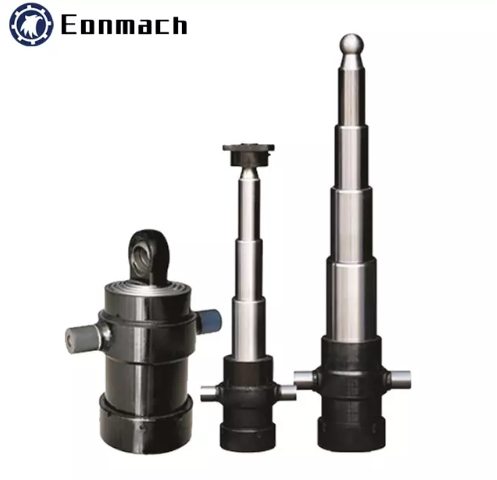
Hydraulic cylinders are in many machines. They do important jobs. They help move, lift, press, or pull heavy things easily. These cylinders are used in factories, building sites, farms, and airplanes. When you use a hydraulic cylinder, you get smooth and controlled movement. This helps make work safer and faster.
Note: Qingdao Eonmach Machinery Company Limited builds each hydraulic cylinder for hard jobs in many industries. You can trust their products to last long and work well under pressure.
When you look inside a hydraulic cylinder, you find several important parts. Each part has a special job. Good design and strong materials help these parts work well together.
Cylinder barrel: This is the main body of the hydraulic cylinder. It holds the pressurized fluid and guides the piston as it moves. Manufacturers use strong materials like steel or special alloys for the barrel. A smooth inside surface helps reduce friction and wear.
Piston: The piston sits inside the barrel. It divides the barrel into two chambers. When fluid enters, the piston moves and creates force. The piston’s design and material affect how long it lasts and how well it works.
Tip: A well-made barrel and piston help your hydraulic cylinder last longer and work better, even under heavy loads.
Component | Material Type | Properties/Applications |
|---|---|---|
Piston Rod | 45# Steel with Hard Chrome | Hard surface, resists wear and rust. |
42CrMo Alloy Steel | Very strong, good for heavy or fast work. | |
Stainless Steel 17-4PH | Strong and resists rust, no coating needed. | |
End Caps | Carbon Steel (Q235/45#) | Used for welded or bolted ends. |
Cast Iron (HT200) | Good for low-pressure jobs. | |
Aluminum Alloy 6061-T6 | Light, used in mobile or flying machines. |
Piston rod: This connects the piston to the machine part that needs to move. It must be strong and smooth to handle force and reduce wear.
End caps: These close both ends of the barrel. They also help mount the cylinder to other parts of the machine.
Seals and gaskets: These keep the fluid inside the cylinder. They stop leaks and help the cylinder work smoothly. Good seals are important for safety and efficiency.
Ports: These are openings where fluid enters and leaves the cylinder. They control the movement of the piston.
You can learn how a hydraulic cylinder works by looking at each step. Each step shows how the cylinder moves and makes force.
You move the control lever. This changes the directional valve. The pump line connects to the cap-end port.
Hydraulic fluid goes into the cap-end chamber. Pressure builds up inside the cylinder.
The piston moves forward. It pushes or pulls the load on the piston rod.
The piston gets to the end of its stroke. It touches an internal stop.
The control valve keeps the piston in place. Pressurized fluid stays in the cylinder.
Tip: For smooth and steady movement, follow these steps. Use good parts for the best results.
Hydraulic fluid is very important in a hydraulic cylinder. The fluid sends force and makes straight movement. When you add pressure, the piston moves inside the barrel. This pushes or pulls the load with a lot of power. You get instant force to move heavy things. Electric systems cannot do this as well.
There are different types of hydraulic fluids. Each type has special features. You can pick the right fluid for your job. The table below lists common fluids and their features:
Type of Hydraulic Fluid | Key Properties |
|---|---|
Biodegradable and Vegetable-Based | Environmentally friendly, made from renewable oils, ideal for operations with potential oil leaks. |
Fire-Resistant | Engineered for high-risk environments, includes synthetic esters to prevent ignition. |
Specialized | Includes low-temperature, high viscosity index, food-grade, and anti-wear fluids for specific needs. |
Lubricity | Reduces friction, protects components, improves efficiency. |
Thermal Stability | Resists breakdown at high temperatures, prevents sludge formation. |
Oxidation Resistance | Lengthens fluid life, maintains smooth operation. |
Demulsibility | Prevents emulsification, reduces corrosion and damage. |
Anti-Foaming | Maintains smooth operation, prevents erratic motion. |
Viscosity Index | Ensures consistent thickness across temperature changes, improving control precision. |
Note: Pick the right hydraulic fluid. This keeps your equipment safe and working well.
Hydraulic cylinders help machines move in many ways. You see these movements in lots of jobs:
Construction: Excavators dig, bulldozers push, cranes lift.
Manufacturing: Assembly lines do tasks, press machines shape things.
Agriculture: Tractors plow fields, harvesters pick crops.
Automotive Industry: Auto lifts raise cars, production lines build vehicles.
Material Handling: Forklifts lift goods, conveyor systems move items.
Mining: Drilling rigs make holes, dump trucks unload stuff.
Marine: Steering parts guide ships, hatch covers open and close.
Entertainment: Theme park rides move safely, stage machines shift sets.
Aerospace: Hangar doors open and close, platforms change height.
Energy Sector: Wind turbines move blades, hydraulic fracturing gets oil.
Alert: Keep your hydraulic cylinder straight and in good shape. This helps you avoid problems like misalignment, rod scoring, or cylinder drift.
Operational Issue | Causes | Solutions |
|---|---|---|
Misalignment | Too much stress on seals, causing leaks. | Change bad seals, check and fix the piston rod, fix alignment. |
Rod Scoring | Dirt in fluid, not enough lubrication. | Use fluid filters, change badly scored rods, add more lubrication. |
Cylinder Drift | Leaks inside, valve problems. | Check and change piston seals, fix or change bad valves. |
Bent Hydraulic Cylinder Rods | Too much weight, wrong use of equipment. | Change bent rods, teach workers how to use equipment right. |
Pitting Corrosion | Water or chemicals in the system. | Clean the system, change pitted rods, use rust-proof fluids. |
Slow Hydraulic Cylinder Response | Fluid too thick or thin, air in the system. | Use the right fluid for the job. |
Tip: Check your cylinder often and use the right fluid. This helps your hydraulic cylinder work well.
Most machines use two main types of cylinders. These are single-acting and double-acting. Each type works in its own way. They are good for different jobs.
Single-acting cylinders move one way with hydraulic force. They need something else, like a spring or gravity, to go back.
Double-acting cylinders use hydraulic pressure to move both ways. You can push and pull with the same cylinder.
Single-acting cylinders have fewer parts. This makes them simple and easy to fix.
Double-acting cylinders have two ports. You can send fluid to either side for better control.
Double-acting cylinders often move back faster. They also give more force when they push out.
Here is a table to compare these two types:
Feature | Single-Acting Cylinders | Double-Acting Cylinders |
|---|---|---|
Advantages | Simple, cost-effective, compact | Moves both ways, precise, faster |
Disadvantages | Needs outside force to retract, slower | More complex, higher cost |
Ideal Applications | Lifting, pushing | Heavy lifting, presses, factory machines |
Some jobs need special cylinders. Telescopic cylinders can stretch much longer than they start. You see them in dump trucks and lifts. They have many parts that slide out, like a telescope. This helps lift heavy things high up.
Special cylinders help in special jobs:
Short-stroke cylinders fit in small spaces. They do not move far but work well.
Locking cylinders have a lock to hold things still. You use them in big machines and building work.
Flanged cylinders have a strong edge for mounting. They are good for factories and farms.
You see hydraulic cylinders in many places. Here are some examples:
Hospital beds, surgery tables, and patient lifts in hospitals
Garbage trucks and recycling machines in sanitation
Tractors and harvesters on farms
Car lifts and dock levelers in garages and warehouses
Qingdao Eonmach Machinery Company Limited makes cylinders for all these uses. You can find their products in building machines, hospital beds, garbage trucks, and more. Their cylinders help you lift, move, and control heavy things safely and easily.
You now know that a hydraulic cylinder turns fluid power into strong, straight movement. The main parts are the barrel, piston, rod, head, base, and seals:
Component | Description |
|---|---|
Cylinder barrel | This is a thick steel tube. It holds the pressurized fluid. It also guides the piston as it moves. |
Piston | The piston splits the barrel into two parts. It changes fluid pressure into straight force. |
Piston rod | The rod links the piston to what you want to move. It sends the force from inside the cylinder. |
Cylinder head | The head is where the piston rod comes out. It has rod seals and wipers to keep things clean. |
Cylinder base | The base closes one end of the barrel. It has places to mount and ports for the fluid. |
Seals, wear rings, and wipers | These stop leaks inside and help the piston move smoothly. |
You can find these cylinders on farms, in factories, in cars, and on ships. Good cylinders from Eonmach help your machines stay safe and work well. Picking the right cylinder helps your business run better every day.
A hydraulic cylinder helps you move or lift heavy things. It changes fluid power into straight-line force. You see it in machines like car lifts, tractors, and garbage trucks.
You should check for leaks, clean the parts, and use the right hydraulic fluid. Regular checks help you spot problems early. Good care makes your cylinder last longer.
You need to pick the right cylinder for each job. Some cylinders fit many machines, but others are made for special uses. Always check the size and force needed.
Eonmach makes strong and safe cylinders. You get products made under ISO9001 standards. Their cylinders work well in cars, hospitals, farms, and waste systems.